
Expanding your store into new countries is one of the fastest ways to grow, but compliance missteps can stall momentum and create costly surprises. To make expansion repeatable, you need a simple, operational checklist that covers customs, tax, product rules, data, and logistics.
To help, here is a practical, EU-focused cross border ecommerce compliance checklist you can use to launch confidently and avoid the most common regulatory traps.
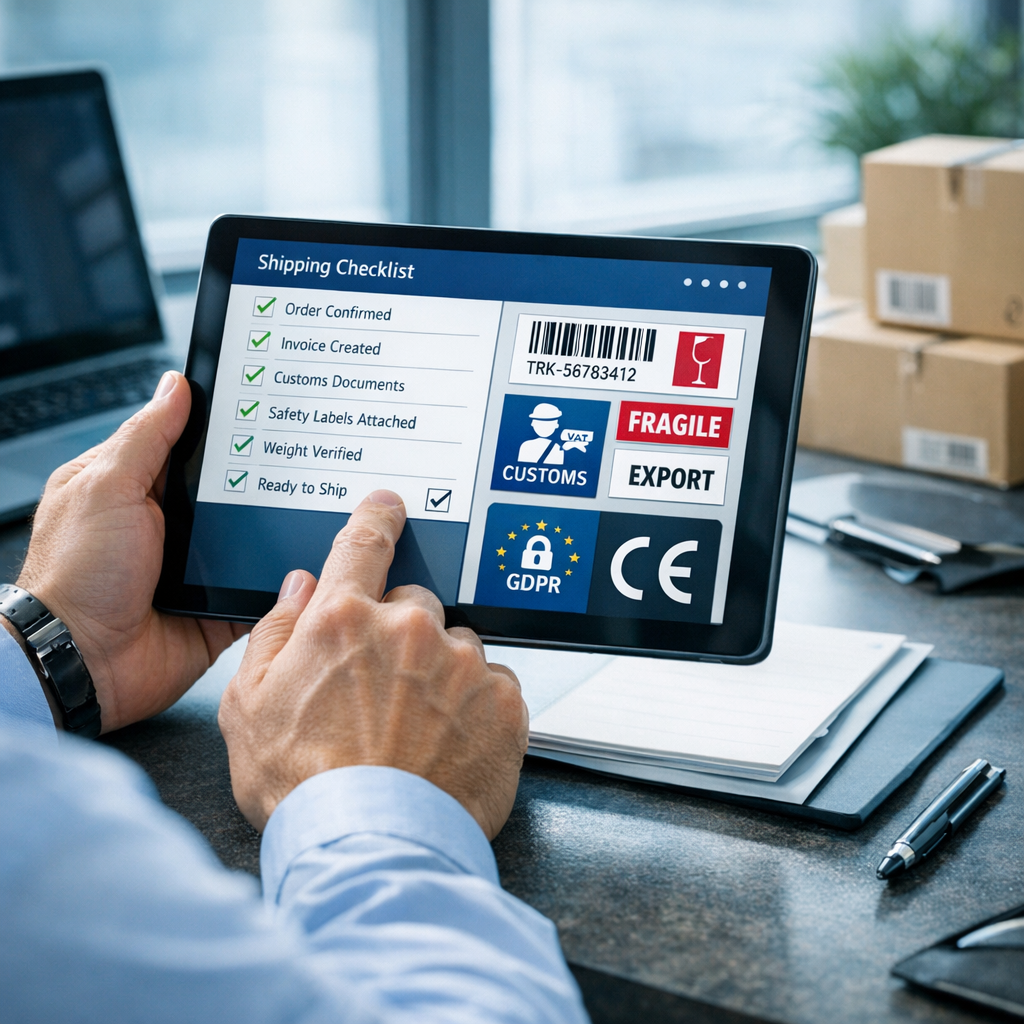
Why compliance matters for cross-border growth
You may be thinking compliance is boring or legalistic, but here is the thing, failure to comply can block shipments, trigger fines, and ruin customer trust. Getting compliance right up front reduces delays, lowers landed costs, and scales your international playbook.
How to use this checklist
Use the 11 steps below as a minimum viable operational checklist for EU expansion. Assign each item to an owner, set a deadline, and confirm with local advisors for industry-specific rules. Treat this as Day 2 operational content for early-stage international business planning.
11-Step Cross Border Ecommerce Compliance Checklist (EU focus)
1) Choose the right legal structure and register where needed
Decide whether you will sell through a local legal entity, a non-established seller model, or marketplace channels. Register for local tax IDs and the VAT regime that fits your model. Action: confirm legal owner, register tax IDs, and store paperwork.
2) VAT registration and OSS setup
Calculate whether you must register VAT in each EU country or use the One-Stop Shop (OSS) for distance sales. Action: estimate sales by country, register for OSS if eligible, and set systems to collect VAT by destination.
3) Classify products with HS codes and check customs rules
Assign accurate HS/Tariff codes, check commodity-specific restrictions, and verify if your products require permits. Action: compile HS codes in your product catalog and get binding tariff information for high-value SKUs.
4) EORI number and customs paperwork
If you import or export into the EU, obtain an EORI number and ensure customs declarations are accurate. Action: set up customs decision workflows, attach commercial invoices and certificates to shipments.
5) Calculate landed cost and duty treatment
Include duties, VAT, freight, and handling in your landed cost model. Decide whether duties are prepaid, DDP, or charged at delivery. Action: publish clear shipping and duties policy at checkout.
6) Product compliance, safety, and labeling
Verify CE marking, REACH chemical rules, toy safety, electrical regulations, or other product-specific EU directives that apply. Confirm language and unit labeling requirements. Action: collect technical files, safety data sheets, and label translations.
7) Packaging waste and producer responsibility rules
EU countries have different Extended Producer Responsibility schemes for packaging. Action: research local packaging fees, register where required, and budget for compliance costs.
8) Consumer rights and returns policy
EU consumers have a minimum statutory right of withdrawal, generally 14 days, plus warranty and returns rules. Your return logistics and refund flow must honor these rights. Action: implement returns label, refunds timeline, and customer-facing policy pages.
9) Data protection and GDPR compliance
Ensure lawful bases for processing customer data, implement privacy notices, data subject request workflows, and secure cross-border data transfers. Action: update privacy policy, enable consent capture, and map data flows.
10) Payments, fraud prevention, and PSD2 SCA
Offer local payment options, ensure Strong Customer Authentication where required, and integrate fraud scoring. Action: test checkout flows with local cards and wallets, and confirm SCA behavior for 3D Secure.
11) Accounting, e-invoicing and reporting
Set up bookkeeping systems that support multi-currency accounting, VAT reporting, and e-invoicing requirements where applicable. Action: configure accounting, automate VAT reports, and schedule periodic compliance reviews.
Common operational checklists and quick wins
- Map each SKU to HS code and local rules, prioritize high-value items.
- Run a landed cost experiment for your top 10 markets before scaling.
- Localize returns and customer service to reduce friction and chargebacks.
- Archive compliance evidence in a single shared folder for audits.
Objections you might have, and how to handle them
"This feels expensive." Yes, it costs time, but the alternative is unpredictability. Start with high-impact markets, automate VAT and customs where possible, and use fulfillment partners with local expertise.
"Our platform handles shipping paperwork." Great, but you are still legally responsible for product compliance, tax registration, and data protection. Confirm responsibilities in contracts.
Practical rollout timeline (30 / 60 / 90 days)
- 0-30 days: legal set up, VAT & OSS decision, EORI number, HS code mapping for top SKUs.
- 31-60 days: finalize product compliance, label translations, payment integration testing.
- 61-90 days: launch in pilot markets, monitor shipments, adjust landed cost, and finalize returns flow.
Frequently asked questions
Do I need VAT registration in every EU country I sell to?
It depends on your sales model and volumes. If you sell from outside the EU, you may register via OSS for distance sales. If you hold stock locally or exceed local thresholds, you must register locally.
What is the One-Stop Shop (OSS) and should I use it?
The OSS simplifies VAT reporting for distance sales to EU consumers by letting you file a single return. It is often the simplest route for DTC sellers, but evaluate if local registration is needed for marketplace or stock-holding models.
How do I know if my product needs CE marking or other certifications?
CE marking applies to product categories covered by EU directives, such as electronics, toys, and PPE. Check the relevant directive for your category and collect technical documentation and testing reports.
What are EU return rules I must follow?
EU consumers generally have a 14-day right of withdrawal for online purchases, with specific refund timelines and labeling requirements. Your public returns policy should reflect the statutory rights in the countries you sell to.
Does GDPR mean I cannot use marketing data across borders?
No, GDPR allows cross-border processing with lawful bases, but you must document legal bases, secure data transfers, and offer data subject rights. Consent-based marketing requires clear opt-ins.
How do customs delays affect my customer experience?
Customs delays increase delivery ETA and create customer service load. Mitigate by offering DDP, providing transparent tracking, and choosing carriers with customs brokerage expertise.
Can marketplaces handle compliance for me?
Marketplaces often offer compliance services, but the seller usually remains responsible for product compliance and tax registration in many cases. Verify the marketplace terms and keep your own compliance records.
Ready to scale internationally?
If you want to move faster with less risk, work with partners who understand EU rules and can operationalize VAT, customs, labeling, and returns. Visit https://www.sell-goal.com to learn how our international expansion services help DTC and wholesale brands grow across borders.
Conclusion
Expanding internationally is a growth multiplier, but it is also an operational discipline. Use this 11-step checklist as a working playbook, own the documentation, assign clear owners, and run a pilot before full roll out. Nail the compliance basics, and scaling across the EU becomes a repeatable advantage.